
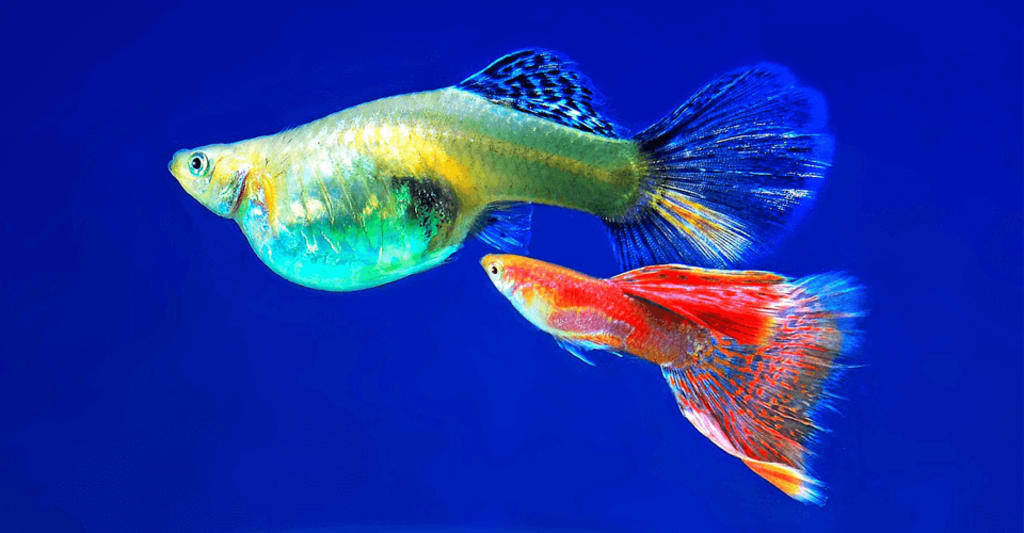
Guppy Fish Breeding: A Step-by-Step Complete Guide for Indian Aquarists
Guppy Fish Breeding: A Step-by-Step Complete Guide for Indian Aquarists
Quick Answer
Guppy fish breed readily in home aquariums with almost no intervention. Keep one male to two females in a tank with dense plants or a floating breeder box, maintain water temperature at 26–28 °C, and feed high-quality protein food twice daily. The female gives birth to live fry after a gestation period that typically ranges from 3 to 6 weeks depending on temperature and individual condition. Feed newborn fry Intan Micro Bits or crushed breeder food from day one.
Key Takeaways
- Guppies are livebearers — the female gives birth to fully-formed, free-swimming fry (no eggs, no hatching required).
- Gestation usually takes 3–6 weeks (influenced by water temperature and female condition). A female can store sperm and produce multiple pregnancies from a single mating.
- Keep 1 male to 2–3 females to prevent males from stressing females to death through constant pursuit.
- Without hiding plants or a breeder box, adult fish will eat nearly all fry within minutes of birth.
- A female guppy typically produces 20–40 fry per birth; mature, well-conditioned females sometimes produce more.
Guppy Breeding at a Glance
| Stage | Typical Timeline | Key Action |
|---|---|---|
| Mating | Day 0 | Maintain 1 male per 2–3 females; condition with varied food |
| Pregnancy | 3–6 weeks | Feed 3× daily; reduce stress; watch for square belly |
| Pre-birth | Final 24–72 hours | Move to breeder box or separate tank |
| Birth | Several hours | Return female after birth |
| Fry growth (early) | Week 1–2 | Feed fine powder food 4–5× daily; 20% water change daily |
| Fry growth (mid) | Week 3–6 | Introduce baby brine shrimp; transition to crumble food |
| Juvenile | Week 8–10 | Sex visible; move to grow-out or community tank |
Understanding Guppy Reproduction
Guppies (Poecilia reticulata) don’t lay eggs — the female carries developing fry internally and gives birth to fully-formed, free-swimming young. No hatching, no egg-guarding, no special setup required for the biology to work. This is why they’re often the first fish anyone successfully breeds.
The female reaches sexual maturity at around 2–3 months old. After a single mating she can store sperm for up to 8 months, meaning one encounter can produce multiple pregnancies. Gestation typically runs 3–6 weeks — closer to 3 at 27–28 °C, closer to 6 in cooler conditions. A typical birth produces somewhere around 20–40 fry, though mature, well-fed females sometimes produce more. She can cycle through a new pregnancy roughly every 28–35 days throughout her active reproductive life of about two years.
The practical upside of all this: a healthy male-female pair in a tank with plants will produce fry with essentially no intervention. The challenge isn’t breeding them — it’s managing how many you end up with.
How to Identify Male and Female Guppies
| Feature | Male | Female |
|---|---|---|
| Body size | Smaller (2.5–3.5 cm) | Larger (4–6 cm) |
| Colouration | Vibrant — reds, blues, yellows, patterns | Mostly grey or silver-grey |
| Tail (caudal) fin | Large and elaborately coloured | Smaller and transparent/grey |
| Anal fin | Modified into a pointed tube (gonopodium) | Triangular, fan-shaped |
| Gravid spot | Not present | Dark spot near anal fin (darkens during pregnancy) |
Setting Up a Guppy Breeding Tank
Option 1: Planted Community Tank (Passive Breeding). Dense java moss, hornwort, or guppy grass provides enough hiding space for some fry to survive naturally. Fry survival rate: Low (5–20%).
Option 2: Floating Breeder Box (Recommended for Beginners). A plastic mesh box floats inside the tank. When fry drop through the mesh into the lower compartment, they are immediately separated from the mother. Available in most aquarium shops for ₹50–₹200. Fry survival rate: High (80–95%).
Option 3: Dedicated Breeding Tank (Best Results). A separate 20–40 litre tank, sponge filter only, dense java moss, no substrate. Fry survival rate: Very high (85–98%).
Conditioning Guppies for Breeding
Conditioning is the step most beginners skip, then wonder why nothing’s happening. Two weeks of richer, more varied food before breeding makes a real difference to egg quality, clutch size, and whether the fish bother spawning at all.
- Intan Guppy Pellets — balanced protein base for daily feeding
- Live daphnia — excellent conditioning trigger; high in protein and natural carotenoids
- Frozen brine shrimp — clean alternative to live food; stimulates spawning
- Frozen bloodworms — high protein, good for conditioning females
The Guppy Breeding Process Step-by-Step
Step 1: Select healthy breeding stock. Choose males with the best colour and tail development. Avoid inbreeding — introduce new males from a different bloodline every 4–6 generations.
Step 2: Condition for 1–2 weeks. Feed high-protein foods 3× daily. You should observe the male displaying intensely to the female — circling her and spreading his fins.
Step 3: Introduce male and female. In a dedicated breeding tank, add the male for 24–48 hours then remove him. The ratio matters: one male per one female means the female is being chased constantly, with no escape. One male to two or three females spreads his attention and lets each female rest.
Step 4: Monitor for pregnancy. The gravid spot will darken and enlarge as the pregnancy progresses. Near delivery, the belly becomes square-shaped.
Step 5: Move the female. When the female appears square-bellied and the gravid spot is very dark (almost black), she is within 24–72 hours of giving birth. Transfer her to the breeding box or dedicated tank.
Step 6: Return the female. After birth is complete, return her to the main tank or conditioning area.
Feeding Guppy Fry
| Age | Food | Frequency |
|---|---|---|
| Day 1–7 | Intan Micro Bits (crushed fine) or liquid fry food | 4–5× per day |
| Day 8–14 | Intan Micro Bits + Intan Breeder & Grower B1 | 4× per day |
| Day 15–30 | Intan Breeder & Grower B1/B2 + baby brine shrimp | 3–4× per day |
| Day 60+ | Intan Guppy Pellets | 2–3× per day |
How to Grow Healthy Guppy Fry Quickly
Three key factors for healthy fry growth:
- Feeding frequency — 4–5 small feedings per day supports faster, healthier growth than 2 larger meals.
- Water change frequency — A 20% change every day might sound excessive but it makes a visible difference in fry growth. Every experienced guppy breeder has noticed that fry in tanks with daily changes outgrow those in weekly-change tanks.
- Stable, warm water — Warm water within the safe range supports faster metabolism, but stability matters more than maximising temperature. Avoid sudden fluctuations.
Common Guppy Breeding Mistakes
Too many males per female. One male guppy will relentlessly pursue females. Use 1 male to 2–3 females minimum. No hiding space for fry. Dense java moss or a floating breeder box is essential. Feeding fry adult-sized food. Newborn guppy fry cannot fit an adult pellet in their mouth. Use fine powder or Intan Micro Bits from day 1. Inbreeding. Breeding siblings or closely related fish continuously leads to genetic issues. Introduce new males from outside bloodlines periodically. Skipping water changes in the fry tank. Daily or every-other-day partial water changes are essential for fast, healthy fry growth.
India-Specific Notes
Indian tap water is generally hard and alkaline — guppies are well-suited to these conditions. The monsoon season (June–September) naturally triggers breeding behaviour in many fish; performing a slightly larger water change with cooler water during this period can stimulate guppies that have been slow to breed. Live food like daphnia and brine shrimp is available from most fish markets in Chennai, Bangalore, Kolkata, and Hyderabad.
Recommended Intan Products
| Use | Product |
|---|---|
| Conditioning breeders | Intan Guppy Pellets |
| Fry food (day 1–14) | Intan Micro Bits |
| Growing fry (2–6 weeks) | Intan Breeder & Grower B1 |
| Juvenile fry (6–10 weeks) | Intan Breeder & Grower B2 |
Frequently Asked Questions
How long does guppy fish breeding take? The gestation period for guppy fish typically ranges from 3 to 6 weeks. Warmer water within the safe range tends to shorten gestation; cooler water extends it.
How many fry do guppy fish have? Guppy females commonly produce 20–40 fry per birth. Mature, well-conditioned females sometimes produce more.
How do I know when my guppy is about to give birth? When her belly appears square-shaped, the gravid spot is very dark (almost black), she rests near the bottom more than usual, and she may stop eating. At this point, she will typically give birth within 24–48 hours.
What is the sex ratio I should keep for guppy breeding? Keep 1 male per 2–3 females. A male guppy will relentlessly pursue any female in the tank. With only one female, she will be harassed constantly, become stressed, and may die prematurely.
What do guppy fry eat in the first week? Very fine food — liquid fry food, infusoria, micro worms, or finely crushed pellets. Intan Micro Bits can be crushed further between two spoons to create a fine powder suitable for newborn guppy fry.


1 comment
When will I know to move the mum over to another tank she is very big and I moved her but she looked very sad and so I moved her back but as soon as I do the boys just were harrassing her I don’t know what Is worse the harrassment or that she is lonely